Urban Animals:
How to Raise Chickens, Goats, and More in Your Backyard.
In 4 full-length online classes, I will show you how you can raise your own superior eggs, milk, honey and meats, AND how to integrate them to enhance your property while improving your vegetable and fruit production, too! The information that I have to share with you will elevate the nutritional, physical and financial health of your family, and create a regenerative system that becomes more productive over time. I will take the guesswork out of the process so that you can enjoy success right out of the box!
Urban Animals: How to Raise Chickens, Goats, and More in Your Backyard is based on tried and true permaculture principles and techniques that really work!
You won't find complicated systems here, or techniques that require you to buy or use special equipment. You also won’t find a sterile "how-to" that reduces farming to providing food and housing. Instead, you'll discover how to confidently team up with nature to raise and grow wholesome, organic food, as it was always intended.
In just 4 classes, you'll be thrilled to discover the pride and satisfaction of raising your own backyard animals, and how simple and fun it really is. No more shelling out your hard earned cash at the grocery store for pricey organic eggs and milk…No more wondering if the food that you serve your family is really free of antibiotics, hormones and GMOs…And no more worry that animals will take up too much time or create unwanted odors -- You'll be delighted with the bounty that you can create, whether you have a small yard or acres!
Kari Spencer
Homesteader and Urban Farmer Extraordinaire
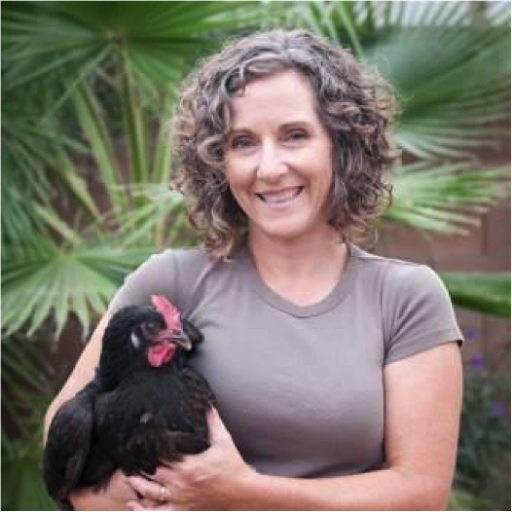
Kari Spencer is a popular local gardening & homesteading speaker. Both a Master Gardener and a Master Farmer, Kari enjoys sharing her passion for growing and raising food with others. In addition to teaching classes all over the city of Phoenix, she is a talented instructor and curriculum writer in the Urban Farming department at Southwest Institute of Healing Arts. Her family operates The Micro Farm Project, a small farm in North Phoenix, where gardens and livestock animals provide her family with fun and food. She loves to experiment with new ways to create a healthier, more self-reliant and sustainable lifestyle, and invites others to join her on the journey.
What you will learn:
First, we're going to discuss what it means to raise food "organically". Again, no complicated or time-consuming systems here: You'll learn the steps to planning a farm that produces healthy food that tastes great and is as fresh as it can possibly be, with no nuisance to the neighbors.
Second, we’ll create a farm that is as self-sustaining as possible, and that produces MORE than we put into it.
Finally, we'll learn what poultry and goats need to be happy and healthy, and how to enhance their environment. You see, many of the usual ways that we raise animals in the city have turned out to be wrong.
Keeping animals segregated from each other? Hauling prepared feeds from the pet store or farm supply store? Throwing yard and animal waste in the dumpster? Supplying food and housing without considering the animals’ other needs or possible contributions? No chickens or bugs allowed in the garden? These conventional methods may all be WRONG.
There's actually a much easier, cheaper, more efficient way to grow and raise food that results in bigger and better harvests every year! I'm going to teach you exactly how to do this so you'll have fresh food on the table every night and more cash in your pocket.
01
Designing a Productive System with Animals:
Before bringing animals home to the farm, it is important to think through the ecological design of your system to ensure that it will be productive, sustainable, and regenerative. In class 1, we will find out how to analyze and design urban farms that are increasingly abundant over time, saving you time and money, yielding healthy food, and benefiting the environment.
02
Chickens & Other Poultry:
Imagine collecting your own fresh eggs daily and having feathered helpers in your garden. In class 2, we will discover how poultry fits into a good ecological design and their many functions on an urban farm. We will also learn about their basic needs and ways to make them profitable financially and ecologically. By the end of this class, you’ll feel more empowered to design your farm, plus you’ll have the inside scoop on raising poultry, from chickens to ducks and turkeys and quail.
03
Goats & Sheep:
By Class 3, you’ll understand what goats and sheep need to thrive, and how incredibly beneficial they can be to the health of your farm and your physical well-being. There’s nothing sweeter than cold, fresh milk produced at home!
04
Value Added - Reducing Costs & Monetizing Your Farm:
By the end of Class 4, you will have more knowledge than many conventional farmers using outmoded techniques. And you will begin to see how the products of an organic farm can add up to much more value than the amount of time, effort and money that you put into it.
Once you complete this course, you’ll have the tools and motivation you need to raise your own food, and your farm may even be up and running! You might be on the cusp of collecting your first eggs or enjoying sweet, raw milk. And you will be on your way to producing more delicious proteins than you ever thought possible!
Who is Water Harvesting For?
- Those that want to learn how to be more self-sufficient by enabling access to an independent water source.
- Those who are seeking alternative ways to reduce their water and energy bills, especially during peak demand.
- Those who want to create a positive environmental impact by reducing the amount of water treated and pumped to your home... thus meeting better standards of water and energy efficiency and reducing water service costs!
- Those that want a clean source of water for plants and landscapes free from fluoride, sodium, and chlorine.
- Those looking to make a difference in their pocketbook and their community by reducing long-term municipal water development needs.
- Those who want to reduce contaminated storm water runoff of chemicals, pesticides, fertilizers, and metals to nearby rivers, streams, and groundwater sources.
- Those who instead of being tethered to a municipal water system, wish to take advantage of untapped resources in their community!
Growing Food, the Basics Works Because It Is Based on 7 Keys
These 7 Keys will help you to harness the power of nature to make gardening easy and economical. Sun, Soil, Sprinklers, Seasons, Sustenance, Seeds and a Simple Strategy…When you get all of these factors right, they equal Sustainable Surplus!
Why sustainable? Because so much of what people do in the garden is unsustainable.
Tilling and turning the soil with backbreaking effort once or twice a year? UNSUSTAINABLE. Repeatedly buying expensive soil amendments at the nursery? UNSUSTAINABLE. Spending time and energy on a garden that doesn’t produce? UNSUSTAINABLE (and no fun, either!)
We're going to stop these unsustainable gardening activities once and for all and clear up the myths and misconceptions that have lead us down the wrong path.
First, we're going to discuss what it means to "grow organically". Again, no complicated or time-consuming systems here: You'll learn how to grow food that tastes great, is as fresh as it can possibly be, and is free of harmful chemicals and GMOs.
Secondly, we’ll create a garden that is as self-sustaining as possible, and that produces more than we put into it.
Finally, we'll learn how to fit gardening into our busy schedules and how to grow lots of food in just minutes a day. You see, many of the gardening techniques that have been taught or that have been handed down to us have turned out to be wrong.
Remember being told that you had to do turn the soil and add fertilizer every year to prepare a garden? Or that your garden had to be laid out in rows? No weeds or bugs allowed! WRONG.
There's actually a much easier, cheaper, more efficient way to garden that results in bigger and better harvests every year! I'm going to teach you exactly how to do this so you'll have fresh food on the table every night and more cash in your pocket.
Plus, I'm going to share with you additional "garden hacks" that will save you time and money and solve many of your gardening challenges.
Take Advantage of Free Resources...
Our water resources are overallocated and as our population grows with continued economic expansion, this puts our water sources at further risk. The process of treating and pumping municipal water also costs money and energy which is reflected in our utilities. Water harvesting reduces this expense by tapping into a free resource. Harvesting water can be a sustainable water supply strategy for communities, especially ones that can't access acceptable water sources.
Grow Healthier Gardens and Landscapes...
Treated municipal water supply usually contains elements such as fluorides, chlorines, sodium, and potassium which disrupts the balance of minerals and nutrients in the soil. Regions that require water softening will have large amounts of sodium present in the water. Supplying your garden with captured water sources will allow you to rest easy knowing that you are using a water source that won't be detrimental to your plants health.
Inspire Your Community...
Water harvesting techniques can educate you and your community on recognizing household water usage and can be a tool to inspire others to conserve water. Explore the various water harvesting equipment available whether it is for your property or an urban building, the possibilities are endless!
Captured Water Minimizes Impacts and Enables Self-Sufficiency...
Why rely on a water source that costs money, energy and is overallocated? In addition, your health and the health of your landscape is not benefiting from the unnatural processes of our water system. Did you know that the costs associated with water are increasing? Groundwater is becoming harder to find and extract, water management and conservation is a rising concern as more homes and buildings are built, stretching water further into scarcity. Captured water reduces the impacts from municipal water demand, decreases erosion and contamination from storm water runoff, and enables self-sufficiency by creating an independent water source free of chemicals and of charge.
Here's what others have to say:
"Kari’s gardening classes taught me everything I needed to know about how to garden…not only the “how” but the “why” of gardening. Now, I have four garden boxes and lots of buckets - a total of 100 square feet of gardening space. My husband and I harvest something from our garden almost every day. Gardening has revolutionized my life."
Erin Bradham
Gardening Student, 2014
"I've taken several of Kari’s classes on a variety of garden related subjects. Her classes have been well thought out, organized and offer great information. She’s always enthusiastic about the material and makes sure each student understands the information thoroughly. The class was always encouraged to ask questions as needed and Kari always had a knowledgeable, in-depth answer for us. I enjoyed her classes and felt confident under her instruction."
David Creech
Landscape Designer, CFdesign -Founder, ModerSteader.com
"We are new to gardening and had a desire to learn about growing food in an urban setting. Kari's class was a wonderful guide! We learned valuable information about soil, sunlight, watering, plot construction, and seed selection. It's obvious that she loves what she does and we are excited about our future as urban farmers!"
Stephanie Kirchheimer
Backyard Gardener
What You Get:
- Four pre-recorded, full-length online classes
In four 1.5-hour classes I'm going to show you how to get started on the path to raising happy, healthy backyard animals. This is an action-oriented program focused on lasting, sustainable results. You're going to start implementing the Action Steps immediately, taking simple but extremely impactful steps that will build on each other week by week over the course of 4 weeks. - Access to the private, member-only Urban Farm Facebook group
There, you'll be able to tap into an online community of urban farmers just like yourself, both new and seasoned. This is a place to ask for advice or guidance, post photos of your gardens, animals and projects, and converse with fellow food-growers. - Downloadable content in the Urban Farm U Member Site
Videos, webinar links, PDFs, plus lists of books and other programs that will enhance your experience and provide next steps. Topics include how animals fit into permaculture design, what egg carton labels really mean, selling eggs, incubators, milking dairy goats, saving water, farm record keeping, profit-making, creating rich compost, and building healthy soil.
Plus, this FREE bonus:
- BONUS: Virtual tour of the The Micro Farm Project
The Micro Farm Project is Kari's family owned urban farm and informational outreach in the heart of Phoenix, Arizona. On a quarter-acre parcel, we produce naturally grown vegetables and fruits, farm-fresh chicken and quail eggs, heritage turkeys, raw goat milk and cheese, lamb, pickles, relishes, jams and jellies, artisan breads, gluten free desserts and other natural goodies. On this tour, you will:
-Explore a real family-owned urban farm from the comfort of your home
-Witness the potential for how much food can be cultivated using natural and sustainable practices on a standard city lot
-See what it entails for an urban farm to produce everything from fruits and vegetables to fowl, goat's milk and more
-Learn from Kari's successes and mistakes
-Be inspired to start or expand your own urban farm
Learn skills that will forever change your perspective of fresh food.
© Copyright 2020 Urban Farm U